Showing posts with label Work Done. Show all posts

Wednesday, May 4, 2022

Garden Record-Keeping

I blog here partly as a means of keeping track of what is going on in my garden. There is a long and honored tradition of garden journal-keeping. In fact, garden records from centuries past are being mined for understanding how weather and climate has changed over time. On a modestly selfish note, I find myself sometimes reviewing these blog posts to see when I did what in the garden, and how it has changed over time. Photos are so important to see what was going on.

Tulips planted in 2018 are starting to fade.
Time to order new bulbs for fall planting.
I just looked back over the April and May entries I made from 2019 to last year. That (2019) was the first year after I lost the Big Spruce and got the fence up, totally changing how my garden functions, and of course June 2019 was when I retired for good and all, giving me a lot more time to work on the garden. I made some ambitious plans then, and I've carried out some of them! But looking at what I did and wrote in past years during the busy spring season has made me sad that I haven't blogged so much here. Even worse, I haven't even always taken pictures of what is going on! I've been busy in the garden (and inside, with seed starting and indoor plants), and I have taken very brief notes of what I've done, but not enough observations or photos of what has been happening. So here, I'm going to do some catch-up blogging. (Note: between writing the first draft of this and now, I've been out there and taken maybe a hundred new photos, so I'd be able to illustrate this and subsequent posts.) It's a grey day, still very wet from last night's downpour, and I had an especially good and vigorous workout earlier this morning, so I'm good with flopping on the couch with the computer actually in my lap. It seems so self-indulgent, with the world going to hell around me, but I'm keeping up with my tiny little piece of it.

Species tulips in the side yard last longer.
Because I started things from seed inside, and bought more things to set out later, I've been impatient with the weather we've been having. We've had some very nice days - rated 10 out of 10 by the Capital Weather Gang - but we continue to experience serious periods of cold weather. It's also often been grey, but rain has been below average (last night with over an inch helped!)  We had temperatures overnight in the 30s last week, and we'll see low 40s this weekend. We skirted the edge of a frost just two weeks ago. I planted peas in the ground in my back veggie bed in early March, and they came up slowly and have only poked along since. (They may have gotten nibbled by rabbits, because I didn't deploy the protective netting until much later.) Peas are traditionally the first crops to be planted, but it's been several years since I tried them. 

The traditional demarcations of spring planting seasons are: (1) As soon as the ground can be worked in the spring; (2) After substantial risk of frost is past; (3) After all danger of frost is past; (4) When night-time temperatures are in the 50s; and (5) When the soil has warmed up. I sat down and figured out when those dates have been lately, and then backed up from those dates to start seeds indoors under lights. But each of those dates has been later than in past years. To be fair, we've actually tracked fairly closely to the "traditional" date for the last frost - but the last several years have been warmer and I bet on it as I bought plants and started seeds. We still haven't gotten to nights in the 50s and warm soil yet, but I think the next two weeks will get us there. 

The ugly but effective grow house,
with Bixby for scale and decoration
My back patio, with two sides brick walls of the house, faces east and south and is very sheltered. I started bringing plants outside to the patio the second week of April, at first bringing them in at night, then finally leaving them there. The bricks absorb heat during the day and provide some warmth at night. I have shelves there, and plants on the lower shelves have a roof over their heads which also helps trap the heat at night. I have a "grow house", a white plastic-covered green house. I've been using it as a shed to store crap for years, but after a major de-cluttering last year, this year I've put some of my plants out there. It warms up substantially during the days, (at least five degrees on a shady day, and up to plus-twenty degrees in the sun!) and it cools to nearly ambient at night. I have a couple of big five-gallon buckets of water in the grow house, and the water heats up during the day and releases heat back into the air as it cools at night, which maybe can keep the air slightly warmer than outside.

This corner has deer protection from the fence
and a surprising amount of sun. I want to move the grill
and get rid of the bush to be able to put potted plants in the sun.
I've been observing the past couple of years, the sun and shade patterns around the house and yard. They are substantially different than they were when I moved in. For years, I've been in denial of the increasing shade from all the trees I planted. I'm finally accepting it, and that has led to some plans to reshape parts of the yard. Leaves have only emerged in the past two weeks (again, I've been impatient) and now I'm getting a better idea of exactly what to do this year. I'm amazed at how different my sun room is, now the leaves are out. My sunny room is now filled with a green, shady, cool, ambience. I intend to deploy a lot more pots outside, and tailor their placement around the yard to the light conditions the plants need.

The back entrance to my house (on the right).
There is a gravel driveway under the grass, to be renewed.
The new stone walkway will run from the end of the driveway
at the house to the gate.
I am contracting for one big landscaping job. The back entrance to my house is the flattest way in. There is a driveway with an initial steep slope about four feet up from the street, but then a gradual slope, and then it's mostly level from the driveway to the kitchen door along the back of my house. And the kitchen door threshold is only two steps up from the ground. (The front entrance has several steps from the street and then more steps on to the front porch.) If ever I have mobility issues, this back entrance may become my main entrance. So I've hired a local landscaping firm to renew my old gravel driveway, and then build a wide (at least 42", wheelchair ready) stone walkway from the driveway to the kitchen door. And to do it without sending the water that currently pools there into my basement. (No point in building a ramp up to the door, I don't actually need it yet and maybe never will.) I'm at the company's mercy on scheduling, but I'm looking forward to having it done at last. Once they are done, there may be more changes I make to the yard around the back. I'm delaying some projects that won't be directly affected until I can assess how things look and feel with the new walkway.

Saturday, March 5, 2022

Notes from Outside and Inside

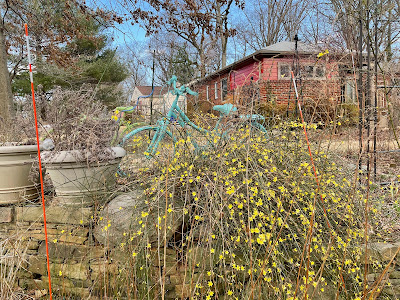
Jasmine on my corner

The last couple of weeks the weather has finally gotten nice enough to do some work outside. It's too early for most planting, and I don't do garden "cleanup" in the traditional sense. I let many leaves and dead plants stand all winter. Some dead stems I knock down but leave in place, I rake leaves off the grass, and I may do a little raking of leaves that have piled up especially thick some places in the garden beds. I clean up and turn over my small vegetable beds. But mostly, I let my naturalistic garden be, deliberately, in order to allow insects to live out their natural life cycles in leaf litter and inside plant stems. It's a bonus that allows a certain degree of laziness to feel virtuous. 

But there is pruning of woody things to do this time of year, before the sap starts flowing. And now that the ground isn't frozen, many weeds stand out greenly from their browner surroundings. The birds and other critters are constantly bringing liriope, english ivy, vinca, and ajuga into places were it is not wanted. To get down and weed is a not too active activity, so it needs to be warm enough to feel comfortable. I've been able to spend a few hours most days doing a bit of this, and it feels great! Besides the subtraction work, I actually got out there and planted peas this week! The traditional day for peas and lettuce to be seeded outside is St Patrick's Day here in DC, but as an experiment I went ahead and did it.

Blooming now, besides the witchhazel, are hellebores and the yellow jasmine at the corner. Crocuses are up - February 19 was the first bloom (I kept checking). Daffodils will get going within a couple of days.

Endless puttering opportunities
Every day I'm puttering with my indoor plants, spending even more time with them than outside. I'm constantly checking water levels rather than watering on any kind of schedule (screwing up watering is the number one problem with potted plants). I pull off dead leaves, transplant and prune, rotate them for even growth or move them around. I've got four of the Aerogardens going, and things transfer from them into either pots with soil or what are called "kratky jars" - simply a container with water and no soil. I've got salad greens growing in two of the gardens, cherry tomato plants (bearing fruit!) in one, and I just started some tomato, pepper, and eggplant seeds in the last. 

Two cherry tomato plants, one red and one orange
Nothing ripe yet!

Isn't this the cutest little pak choi?
I started more seeds, as much for looks as eating


Wednesday, October 27, 2021

Lilies


 The glory of my June garden is the patch of lilies i planted in the fall of 2018. It was a set of 25 bulbs sold by White Flower Farm called Strawberries and Cream. (WFF are masters of marketing.) They bloomed for the first time my first month of retirement, June 2019. Sadly, in 2020, I had to dig up most of them because of the gas company requirements. I put them back, and most but not all survived. I missed the peak this year by being away the first 10 days of June. They were still lovely!


I decided to refresh the patch with an infusion of new bulbs- again, the same mix from the same source. The bulbs arrived today, and went into the ground right away. I often aspire to this promptness, but rarely execute it, so yay me! Here’s hoping for a great display next year!


Saturday, October 16, 2021

Opening Up

There is an extra satisfaction in garden clean-up in the fall because plants are done growing for the most part, so things pulled out or cut back stay gone. My front entrance was way overgrown. It wasn’t possible to get to the front door without brushing against some plants. This included long tendrils from a thorny rose bush! 

I like having a wide, easy-to-navigate entrance, so I spent a couple of hours on this. Here are before and after shots. It’s honestly kind of subtle, but it creates so much more of an open and welcoming feeling. Bonus: it’ll be easier to shovel snow, without the plants growing over the sides, should that become necessary.


Thursday, October 14, 2021

Another Rain Garden

I've had a big problem with drainage on my side yard. This isn't a problem for my basement, but after big rains the water has pooled there for some time. Last winter we had a stint of snow, warming to thaw it, followed by several days of a deep freeze, and that section of my yard turned into a skating rink. 

First iteration of rain basin, perking acceptably

Yards on my street tend to be mostly level, little plateaus created by bulldozers. But then there are steep slopes before the ground levels out to the next yard. This side of my yard is deeply shady, and slopes gradually to the fence, after which it drops down a whole story of a house. My ground is level with my next door neighbor's roof. This is great for privacy. It seemed, however, to be a bad idea to solve my drainage problem by sending it all down the slope to the foundation of the house next door - especially when I know they already have problems with water in their basement. Besides, I'm pretty sure water coursing down that steep hill will drive significant erosion in the slope, resulting eventually in my lovely fence toppling over down the hill. Deluges are becoming more frequent, and they drive much more erosion than the same amount of water spread out over a longer time.

Beginning of the trench

After some years of studying the problem, watching the movement of water through my yard, measuring slopes with a laser level, I decided to run french drains along the side to the front, where I have a small space far enough from trees, my house, and the drop-off to put in another rain garden. The natural slope of the land is from back to front so this working with gravity in my favor. I have a downspout off the roof gutters at the back side corner of my house which would feed directly into the drains. I have another downspout along the back of my house, and I would allow that to drain on the surface, where it should run down across my grass to the low ground in the yard where the porous french drains would channel it out of the area.

This was going to be a much bigger project than my front rain garden, because I would be starting from scratch. I don't think I would have had the gumption to tackle it without the boost from challenging myself in my vacations this summer.

First, I dug up and set aside the large stepping stones that made a path along the side from the back to the front. I needed the wheeled dolly to move many of the huge stones. Then, I laid out the drainage basin area in front, and dug it out with a shovel to about 18". I used most of the displaced soil to bank up the sides of the basin, especially towards the down slope. It dug fairly easily, but where I stopped the looser top soil had yielded to some hard clay. I dug down further into that hard-packed area, and mixed with the clay several bags of locally-generated compost, filling the basin partially back up. I filled the basin with water, and watched it drain - it took about an hour to perk through the clay and soil. That seemed promising.

The trench gets deeper

I trenched backwards from the basin along the house to the back yard. The first layer of the trench was done solely by hand, but there were only 2"-4" of topsoil there before I reached clay (I just put it to the side as I went). I have an electric roto-tiller, and so I got into a routine of running through the trench with the rototiller, loosening the clay. Then I would come back with a spade and remove the loosened soil for a couple of inches, tossing stones to the downside and dirt to the upside. There were some roots that required sawing by hand. (I didn't worry too much about damage to any trees, as the trench is about ten feet from the house, so the roots couldn't have traveled much further than where I cut them off.)  

This was a very big undertaking. It took me maybe five or six days of two hour stints of rototilling and digging to get the trench as deep as I was willing to go. This includes one day of rototiller repair, when I got it too close to a metal mesh fence and the blades got stuck in the fence. I had to pretty much disassemble the whole machine to disentangle it from the fence, and then put it back together again. 

During the deluge. See the drain pipe sticking out

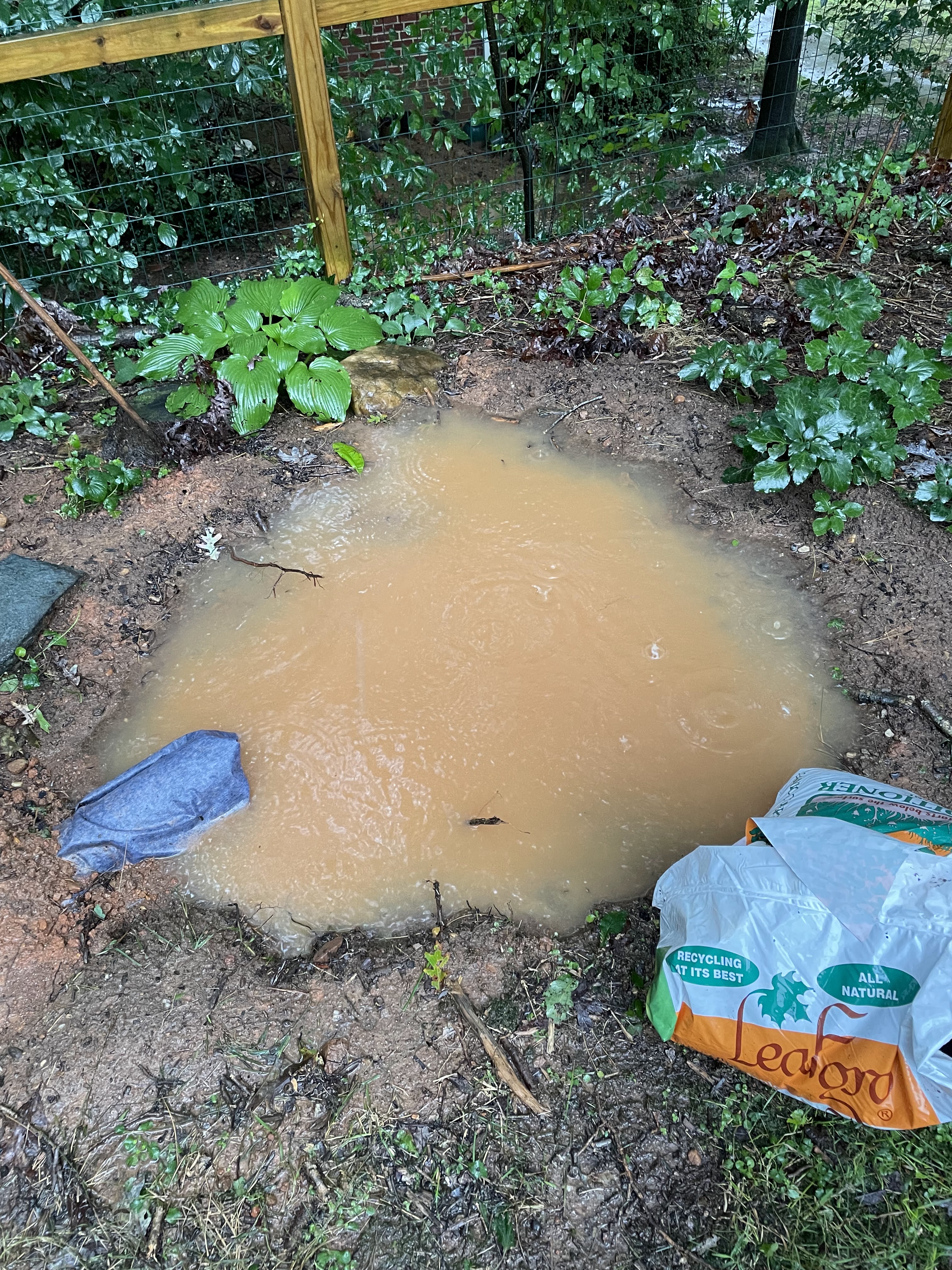
Before I was all the way done with the trenching, we had a big rain - about 1.4" of rain in a few hours. I hooked the drain pipes together in advance of the rain, and watched how it worked. The good news is water ran nicely along the system as planned. The bad news is the rain garden basin wasn't nearly big enough, and it overflowed. The water that was collected there took over 18 hours to drain away - I figure that long time was because the ground was saturated and there was no place for it to perk to. So after it had dried out some, I resumed digging and made it bigger in circumference. I also worked on the berm and tried to slope the sides so that overflow would move in the direction of my main front garden, not over the edge.

Finally I declared the trench as deep as it was going to go. I lined it with landscape fabric, put down pond stones in the bottom of the trench, laid in the porous drain pipes, wrapped the landscape fabric around it like a blanket, and covered it over with the displaced dirt. Hooray!


Bixby digging

I set the stepping stones back on the surface. I still need to sink and seat them properly, on the to-do list. But I want to make sure everything has settled in place before I expend too much effort leveling them out. I should note that I have voles actively tunneling around and between the stepping stones. When I dug my trench I apparently cut through a major passageway, and they have been rebuilding. Bixby entertained himself going after them - it seems he can smell and hear them from the surface. So sometimes I would rake an area smooth, only to have to step and smash new vole tunnels, and rake dirt back into the holes Bixby had dug.

Stepping stones and plants in place


I planted white turtleheads into the rain basin, along with transplanting a single existing pink turtlehead that had popped up away from my main patch.  Along the side of the house - very deeply shady - I put in a grand total of about 30 plants - three kinds of ferns and three kinds of sedges. I planted them pretty densely and I have hopes of a green area with contrasting shades, heights and textures, that needs only minimal management. 

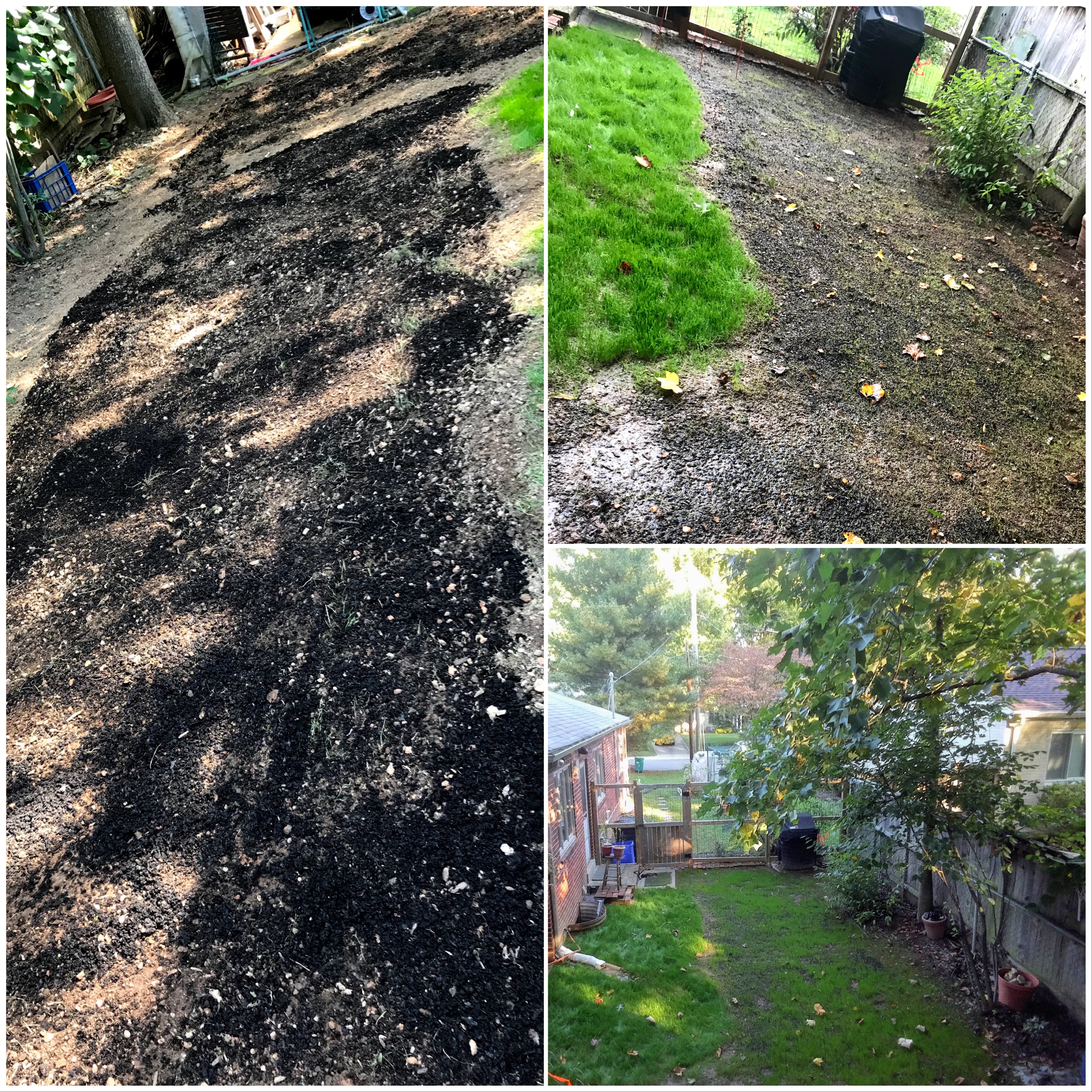
In the rest of the back / side yard, a flat open area, I planned to plant grass. I dug up the biggest weeds by hand. Then I rototilled the whole area to loosen the hard packed soil. Then, I distributed compost over the whole area, and rototilled it again to mix it in. Next I raked the whole area smooth, and tamped it down with my feet. Lastly, I spread bags of special "lawn soil" over the top, raking again, and finally, in advance of the first anticipated rain for several days, seeded it by hand. 

Baby grass! (I have to blow the leaves out-no raking yet)


Yay, ten days later, I've got baby grasses coming along! Last fall, when I planted grass inside the fenced yard, I felt I needed to protect it from Rocky's big feet and questing mouth. Now, I'm not too worried about little Bixby dancing across the tender shoots, but I monitor him and don't let him start digging for voles.

Whew! All told, over a month has elapsed. And as I said, it was years in the planning. We haven't had a downpour since the once that overflowed, (before I was finished) so I don't know how well it will do, but I'm fairly confident it will make a substantial difference.


Monday, July 26, 2021

Rain Garden

 Much of my gardening is driven by changing light conditions - trees grow, trees fall, buildings are built, and the light changes. When the giant spruce fell in my yard in March 2018, conditions changed substantially and the ripple effect continues. 

Peculiar blossoms and fruits
I had a Carolina sweetshrub bush, bought and planted in the waning days of the last century, in front of my house. It was one of several bushes planted in a little thicket beside the walk to my front door, deliberately to create privacy and block views from the street into my house and yard. I only put in shade-adapted natives: the sweetshrub, several blueberries, shadbush, dogwood, oakleaf hydrangea, arrowwood viburnum and cranberry viburnum. For almost two decades the Norway spruce overtopped them and provided shade from deep to dappled, and so they all poked along, establishing roots, growing slowly, intertwining as they way. When the spruce fell, the brakes came off! Now, it is a thriving deep dense thicket, ripe with berries and caterpillars and thus a prime bird habitat.

The sweetshrub, planted at the end of the thicket, was a real winner in the light-and-water sweepstakes. It turns out, this bush can spread by sending out underground suckers, creating a thicket all its own encroaching both on the other bushes and the lawn in the other direction. I realized by the year after the tree fell that it was dominating the space and might have to go. As I thought about it, I grew enamored of the idea of making prime full-sun space available for a rain garden. But it would be a considerable project. 

I dove into the thicket periodically to methodically dig out suckers, beginning with the ones farthest from the main bush. A few of the suckers I transplanted to the opposite end of my yard where there is currently deep shade. Last year, I got the size of the bush down to maybe three feet in diameter, and cut it all off to about four feet high. I kept eying the standing corpse and dreading the task of digging it out.

It's ripe for the plucking!
Houseguests to the rescue! Last October my boat partner and her husband vacationed in my basement for a week (almost as nice as their aborted trip to the Azores, no?)  And one lovely day while they were staying, my sailing partner and I indulged ourselves with weekday sailing, leaving her prone-to-seasickness husband to stay behind and work on his book. But, he asked for anything that needed doing outside. I suspect he wanted to mow the grass, but I pointed out the bush and where the tools were kept, kind of as a joke. But we came home to find the bush gone, all of its sticks bundled for removal and the roots out of the ground, a tidy hole in the ground left behind.

Waiting for next steps

All spring I worried over what to do next. I had spoken to a local contractor about doing a rain garden project, but he never pursued me and I'm past begging for folks to come do work I could do myself. I knew I had to dig out the space, connect to a buried drain from the roof gutters, modify the soil, buy lots of plants. It seemed a big and daunting project, and I did nothing about it. Every time I walked past the scar left behind it gnawed at me.

But, the kedge (planning a big difficult trip to make myself get in better shape) worked! In fact, not only am I in better physical shape, but mentally I'm more ready to tackle difficult things. And, once I got into it, making the rain garden was very manageable.

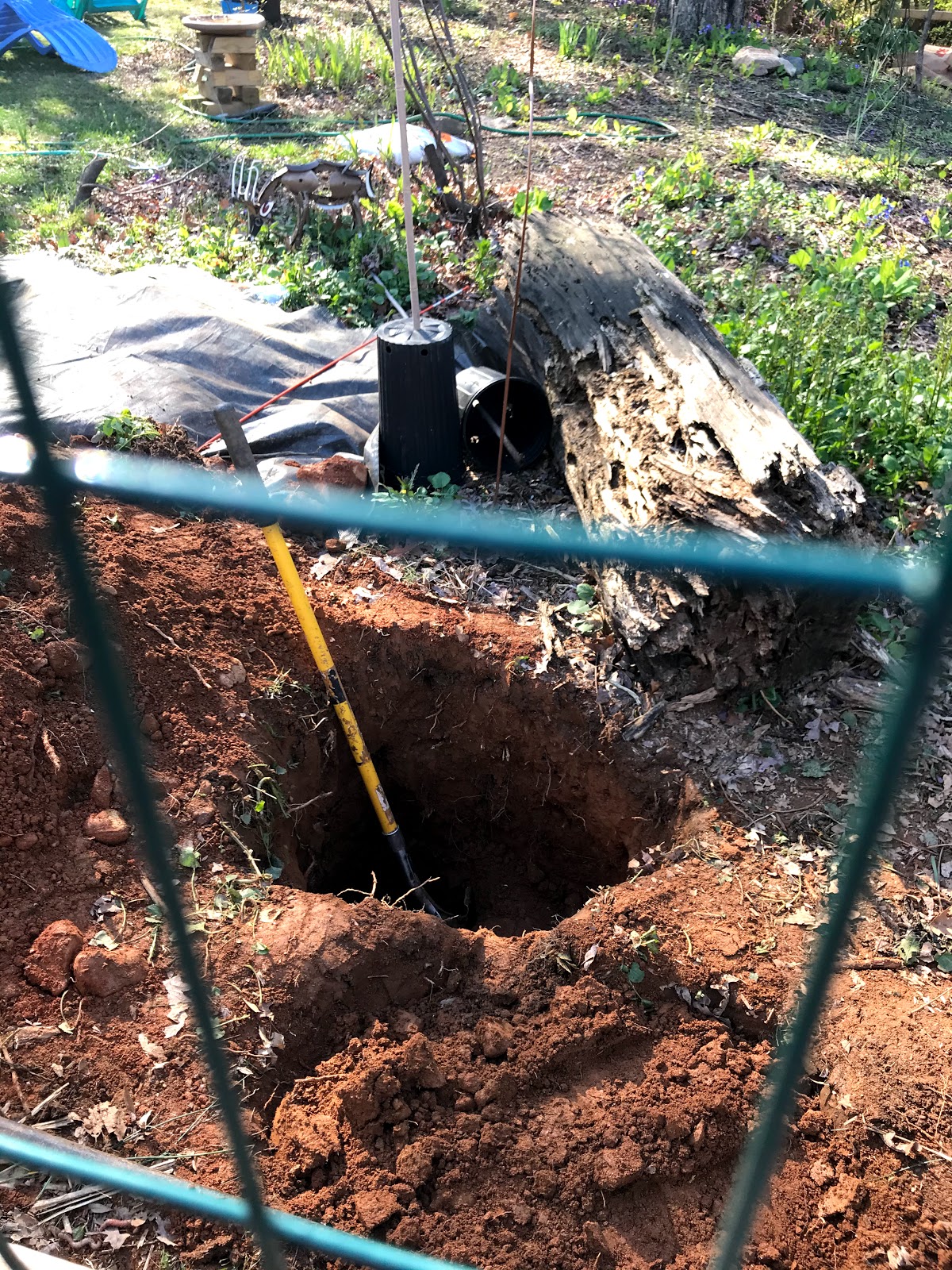
So, I dug out the space.

I modified the soil.


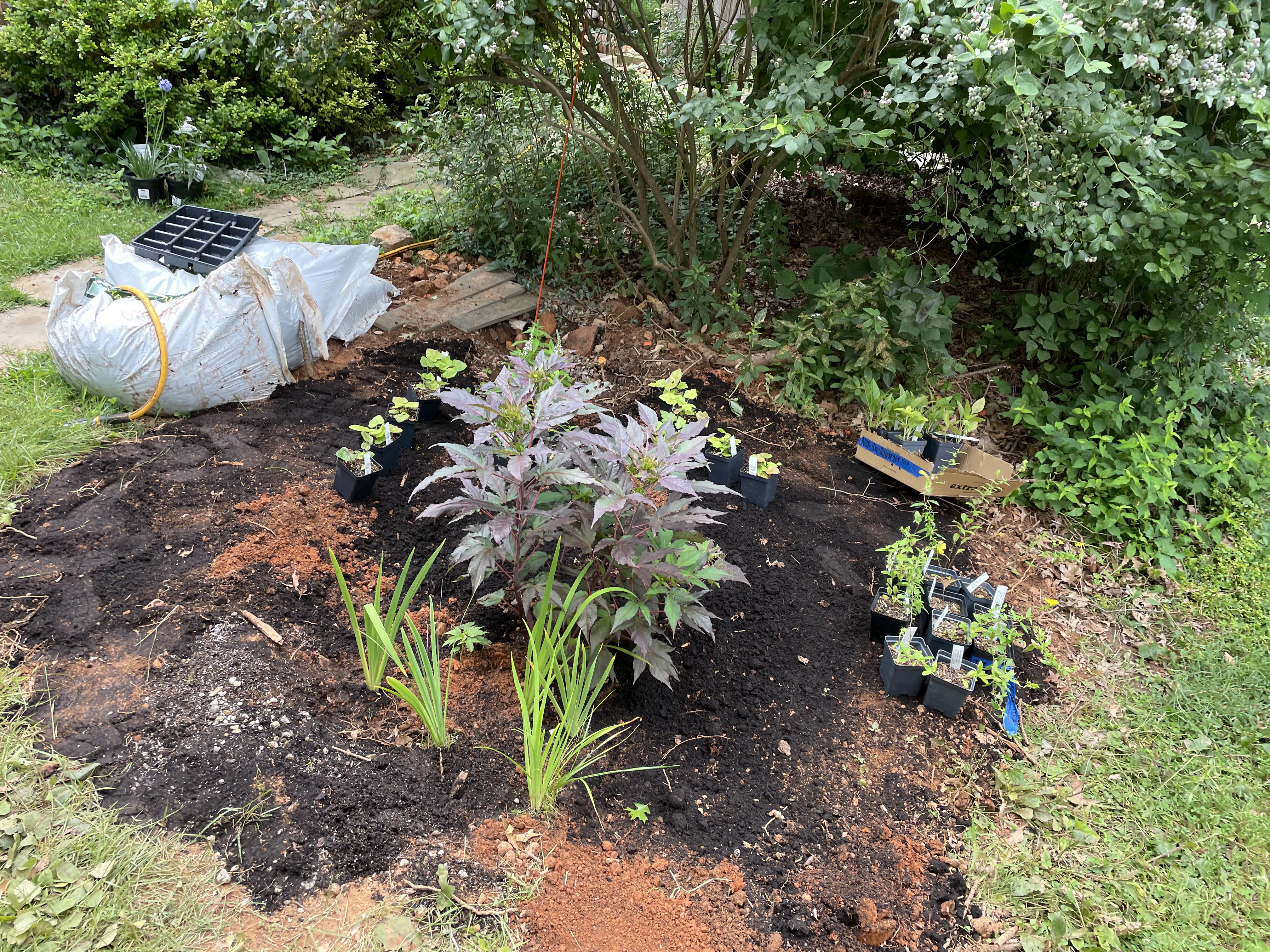
I bought some plants and put them in. It needs more plants, but July is not a great time to acquire plants - spring ones are gone, fall ones are not in. Some things I wanted are not available, and I may end up shopping my yard to move some things from elsewhere. Fall is a great time to do this.

I mulched the heck out of it.


Finally, we had some rain and I was able to watch as rain from the roof drained through the pipe and into the garden, where it filled up and then drained slowly over the course of some hours just as planned!

The one sad thing is this is still the deer highway where they come from the creek into my yard (to eat all my apples). So far, that hasn't been an issue with what I've put in. I'll continue to look for less appetizing plants.

EDIT: As it turns out, last night (evening of the day I wrote this) we got 1.5” of rain in 25 minutes! Towards the end of the downpour (when I thought it was safe) I went out to look. There were a good 6” of water in the rain garden throughout the bowl, with active draining from the roof. When I went out about three hours later, it had all drained away. Exactly the way it’s supposed to work! 

Sunday, April 4, 2021

What's Been Happening in the Garden?

Well, quite a lot has been happening in the garden. I jot some notes down as I go, but I'm not meticulously recording everything.

Early spring is all purple crocus
and yellow daffodils
This time of year, there is an enormous amount of work to do, but also I can enjoy the fruits of previous years' work. Since last I wrote in February, we've been through the extra-early witch-hazel and winter jasmine, and early to late crocuses. Daffodils are mid-season now, and the first tulips are showing color rather than foliage. (Two of the hellebores I transplanted last year are doing very well in the front bed along the house. I think I transplanted more than two, but I'm satisfied that at least two made it.)  Little plants are sprouting up everywhere, and I'm trying to remember what they will become. The redbuds and serviceberries have just started to bloom, and the dead leaves are almost down from the pin oak on the corner. Now is the beginning of the native spring ephemerals, quickly making chlorophyll and flowers and seeds before their associated native trees leaf out and shade them back into senescence. The virginia bluebells, the most showy example of these, are doing ok, but may not match the displays of some other years.
In early March, suddenly the weather turned nice, and we had two straight weeks of nice warm and sunny days - with no rain. It's not great to go that long without rain, but it sure was nice to haul the porch furniture cushions out and not have to pull them back in for many days in the row. Of course, the warm weather got me moving outside. I'm not sure, looking around, I have a lot to show for my efforts, but efforts there have been. Most of it, so far, has been cleanup and weeding, so not so dramatic as planting new things. 

I did, on impulse, buy some cold season vegetables and put them into the back vegetable bed. I haven't

Bloodroot - spring ephemeral

yet put up the net guard on that back bed. I planted four rows of vegetables in half the bed: onions, broccoli, chard, and some miniature chinese cabbage. Oddly, about two weeks later, the broccoli row was empty - something came through and ate just that. I need new plants to fill in that gap.

At the same time, I bought pansies - several different shades of purple. I put them in the pots on the corner, and as has happened before, something came by and uprooted some of the plants, leaving them lying on top of the soil with the roots exposed. I suspect deer are the culprits in both the missing broccoli and the uprooted pansies, though I haven't eliminated squirrels and rabbits as suspects.

I planted grass seed last year in the back yard, and for a while it seemed I might actually have a lawn in the back. But then, streaks of it yellowed and died. Now I have many spots of dirt in between actual grass. My research suggests a virus, but there wasn't much guidance about how to defeat it without spreading nasty chemicals. I also have some bare spots where my big dog pees multiple times a day. I did add some new topsoil to some low and bare spots, and then overseeded the whole area. That was just a few days ago, and I have no baby grasses sticking up yet, but I remain hopeful. I have to water at least twice a day now until the babies establish, or I declare the area dead. I have another area I want to dig up, add new topsoil, level out and seed, but it's a big job. I keep adding to the job, potentially making it bigger, by thinking about digging really deep and burying some drain pipes to be a dry well, as this is the low spot where the water accumulates before it finally surges over the edge and down the hill into my neighbor's basement.

I bought my first batch of perennials this week, and today's plans include planting them. I'm trying to hold off buying more until I get these planted. I do have a history of overbuying, and not getting them all in before they die. But first, I have to weed the places I intend to put them. 

The Grill-to-be
I've also bought things. My gas grill has been broken (sometimes usable) for two years, and two years of youtube fixit videos and spare parts finally made me give up in frustration. But the new one I bought came in a big, 175 pound box. I managed to wheel the box on a dolly to near where it was to go, and then it took many many hours to put it together. On my birthday, I went to Ikea (celebrating fully vaccinated!) and bought their only briefly available garden furniture - I suspect this stuff will be much easier to get together.

Tuesday, December 1, 2020

Late Fall


Oak leaf hydrangea
A gardening book I just finished noted that almost any Fall foliage looks terrific when backlit. So true! And, a reason for planting good foliage plants on the west side of the yard, where the late Fall sun will be at a low angle and highlight it nicely. 

Almost all of the tree leaves are down - except for those that cling all winter like the pin oak on the corner. I've raked / blown / composted in the back a lot, but not so much in the front. I wanted to be sure to keep leaves off the new baby grass I planted. I do need to do a cleanup on the front, however, or they will mat down and smother things. 

NOT backlit - but still good -
St John's Wort

Aside from that, I may need to do some work on closing off the fenced part of my yard more securely, due to smaller, livelier dogs being able to escape.

Monday, October 19, 2020

Grass

 The most vigorous project I’ve been intermittently working on is trying to actually grow a lawn in the spaces where I mow. In my sunny side yard, I’ve got a vigorous zoysia lawn that could stand up to a soccer match. But in my back and front, I’ve mowed infrequently and done little to nothing to try to foster grass versus crabgrass and other weeds.

Lawns have a deservedly bad rap. A perfect traditional lawn requires both labor and chemical inputs. I will never do that. I take no pride in having a perfect lawn. What I want is a green cover that can take footsteps and not erode. My sunny zoysia side yard meets that criteria without a lot of work. It only gets mowed - but pretty much never more often than every two weeks (in spring) and I’ve gone six weeks or more in hot high summer or fall. Sometimes (rarely) I dig out weeds like dandelions, but it’s so dense they don’t get a lot of footholds.

But my front and back yards have been sad territories, where a succession of weeds also leads to bare, muddy spots, and I fear runoff into my neighbor’s yard and the street. This year, I’ve been hanging out in the yard a lot, with the dog, and it’s really been nagging at me. I’ve maximized the part of my yard that is not lawn, that doesn’t need mowing, but I want to have space in the back (inside the fence and private)for me and the dog to move around. As is not unusual with me, I almost accidentally started a small project that has turned into a major renovation.

It all started with wanting to get rid of the azalea outside my kitchen window. One of my legacy azaleas, it was right beside the kitchen door and was infested with english ivy and a vine known commonly and accurately as “tear thumb”. Like all Japanese azaleas, it looked terrific for a week or so in the spring, and the rest of the time just sat there. It’s only wildlife value was providing cover and perches to the birds - no insects or other food. Sitting on my patio I had contemplated pulling it out, and on a lovely, not too hot day at the end of August, when it had recently rained so the ground was soft, I started digging. It took several hours, but I got it, roots and all. I raked it smooth, opened the huge bag of grass seed I had bought and spread it by hand. I fenced it off from the dog, watered it three times a day per instructions, and about a week later tiny little grass plants had sprouted! I was so excited! Time to start the next phase.

When I started digging, I realized I had bitten off more than I could chew. The first small patch I had planted had first been dug up to get the bush out. This next section was hard work to fork up. I already knew I wanted to do most of the backyard, so I bought a rototiller. It’s electric, rated “medium duty”, and it cost only 2x what it would cost to rent for a single day. It is a little bit scary to use, but it gets the job done. So September 12 I planted section 2 (and over seeded the many bare spots of section 1) and a week later I had many cute baby grasses sprouting up. More success! Keep going!

But, as so often happens, I took a digression. I had been planning to clean out my two garden sheds, because I thought it was ridiculous to have two sheds. One is very ugly, and the other needs repair. Cleaning them out meant pulling all the crap out of both, and then thoughtfully deciding what to get rid of (crap left over from the basement reno, mostly) and what to keep, and how to store it. A fine stretch of fall weather gave me a few days without rain where stuff could be spread all over. I’m happy with the organization for tools and garden supplies I ended up with in the red wood shed, and I’m still contemplating what to do with the ugly plastic white shed. It has a very sturdy metal pipe frame, and I could use a place to sit outside out of the rain, and to store things out of the elements during winter. I’ll mull over the winter. 

So finally, I had cleared out enough of the back to start on the next logical but much larger section. It took me a couple of days to rototill, because I kept stopping to rake up the crab grass or bend over and pull it out by the roots. I’m afraid it’ll have gone to seed anyway, but I wanted to do at least a decent job, though I know it’s far from perfect.. I switched the dog-barrier to defend the new territory (because the first two patches were thick enough to walk on and even mow!) and broadcast the seeds towards the end of September. Again, in about a week, baby grasses appeared, and it is nearly at the mowing stage! Three to four weeks, but again I did some overseeding of bare spots a couple of weeks in. Now, the voles have really gone to town, tunneling through the new looser earth. I walk over their tunnels and push them down, but I don’t know how that will affect my baby grasses.

I’ve got one more backyard patch to plant, but I took some digressions. I turned over by hand a small place by the front door that was purely mud (where it had been dug up for the gas meter in June) and planted more grass seed. I also raked and pulled crabgrass and wild strawberry from an adjacent front patch, and planted grass seed in raked furrows, without turning it over completely. I’m not going to get to that spot with serious prep this year, so I’m curious to see if the overseeding will do anything. I’ve got some plants to plant elsewhere, and some structural issues to improve drainage. I haven’t completely decided whether the drainage solution will expand into my remaining back yard future lawn, so that’s a great excuse to avoid hauling out the rototiller again.

The clock is ticking on cold weather, however. There is a limited window to do this. I’d like to get it done this year. Just not right now.

Tuesday, September 15, 2020

Vegetable Wrap-Up

 I cleaned up my single vegetable bed this week. I had planted broccoli, zucchini, cucumbers, beans, and chard. 

The broccoli was the star for the year. I had it tried once before, but the deer got to it and it was never appetizing. But this year, it was beautiful. I planted it in March, because it was the most interesting vegetable offered at Home Depot in my last shopping spree before locking down. After I harvested the main heads on each of the six plants, side shoots kept coming until sometime in  late July when I left it alone and the plants started to rot and die in the moisture and heat. I pulled the sad remnants out and tossed them.

The beans were a success, I guess. I planted two varieties from seed, and made three good harvests. Many of the plants were looking barely alive when I pulled them out just now, but I did get a sparse harvest off the dwindling plants. I’m not terribly enthusiastic because, unlike the broccoli, it wasn’t such a treat to eat them. I’m not sure I’ll give space to beans next year.

The cucumber was squeezed in where there really wasn’t room. I grew it up a trellis, and got one fruit. Then the plant died, possibly from my longtime and apparently still active zucchini curse. 

I squeezed the chard in between the broccoli and the zucchini, and got a meal‘s worth of leaves before they were overwhelmed by their neighbors. Definitely worth it. 

I planted maybe three different varieties of zucchini, both from plants and from seeds.  So far, I’ve harvested one single small zucchini. I have had a plethora of beautiful orange male zucchini blossoms, and few female ones. When I crawled around on the ground cleaning up the bed, several dead plants came away as I simply moved my hand along the ground. I tried to clean up all the dead and rotting matter, and it appears I may have a couple of actually (apparently) healthy zucchini plants in there. Except for some smallish basil plants on the edges, they are the only plants left in the bed and they seemed happy to be cleaned up and able to breathe freely. I discovered a female flower on one of the vines, and performed sex on it by dismembering a male blossom and smearing the pollen from the stamen on the hopefully receptive pistils. So maybe I’ll get a second zucchini! 

The dead squash and cucumbers probably were suffering from the squash vine borer- a drab moth that lays  its eggs on cucurbit vines. The caterpillars snack their way through the main stems of the plants, usually but not always killing the plant on their way. This has been the bane of my squash attempts, and I have never yet suffered from a surplus of zucchini. 

I have two cherry tomato plants in pots, and I continue to get a steady trickle of tomatoes. It would be more, but the deer have nibbled at them more than once, and they do not set fruit in the hottest weather. 

Saturday, July 11, 2020

Apres Moi, Le Deluge?

Broccoli, tomatoes, green beans, cucumbers, zucchini, chard
I harvested yesterday - a much bigger haul than I expected.

I knew I had to harvest the continuing sprouting of side shoots from the broccoli - this is much more broccoli than I ever expected. My first venture into broccoli - highly successful! But when I unzipped my crop cage on the raised bed to go in there, I realized it was time to perform some basic hygiene on all the veggies.
Cherry tomato post pruning

I only have a couple of cherry tomato plants in pots this year, because my plants in the raised bed last year succumbed to what I decided was a virus. I was really sad to see my plants in pots also had yellowing leaves, primarily on the bottom. The internet assured me it was probably the virus, and suggested cutting off all the apparently infected leaves. I suspect the virus got there because I am using plant supports from last year, without actually washing them. I never have, but my books recommend a wipe with bleach at the start of the season, for this specific reason. Tools as well. It's too late for the supports, but I can clean up the tools. I spent a pleasant several minutes pruning and carefully tossing ugly leaves. As always, with pruning the trick is knowing when to stop. Let's hope the plants pull through.

My raised bed is planted very thickly, and the plants are all on top of each other, and there were many yellow leaves at the bottom. Inspired by my tomato pruning, I decided to tackle the whole bed. This would also allow me to really examine what is there, because with it all zipped up, and all of the thick foliage, it's hard to tell what is actually going on as far as blooming and producing is concerned. So I unzipped and raised the sides of the covering, got on my hands and knees, and cleaned and harvested. The chard was almost completely overshadowed by the zucchini foliage, so I decided to take all of the outer leaves and see what happens to the residual plants.

I'm really happy with the way the clean-up went, though I started out planning on spending 15 minutes and ended up spending three hours. There is a specific warning against handling wet foliage (especially bean plants) and it has been very rainy and damp most mornings. Yesterday, Friday, dawned drier and I went to town. Now, there is less rot and better airflow. It can only help.

Broc in the foreground, zucchini in the middle,
cuke on the left, beans on the far end.
My zucchini plants have almost all male flowers. Some years, those are the only flowers I ever have, never any fruit. I have a bad history with zucchini - never have I drowned in them. A large part of that is because of a pest called "squash vine borer" - a butterfly lays eggs in the main thick vine of the plant, the caterpillars eat their way out, and the plants wither. I think the mesh around the bed may prevent that by being a bit too fine for their wings. So could this be the year I have the classic over-supply of squash?

I bought plants and seeds late, and I was stuck with what they had. Zucchini was easy - but then I also bought packets of beans, both pole and bush. I had noted a bean or two, from outside the bed, but when I was down into the details I ended up with a whole pound! Sadly, I'm not so wild for fresh green beans. I'll cook and eat them, since they are mine. But fresh beans are one of the foods where the hassle of tip-and-tailing them, versus pulling a bag out of the freezer, hasn't generally shown me to be worth the effort. What are your favorite bean recipes? I have a feeling there may be a lot of them. 

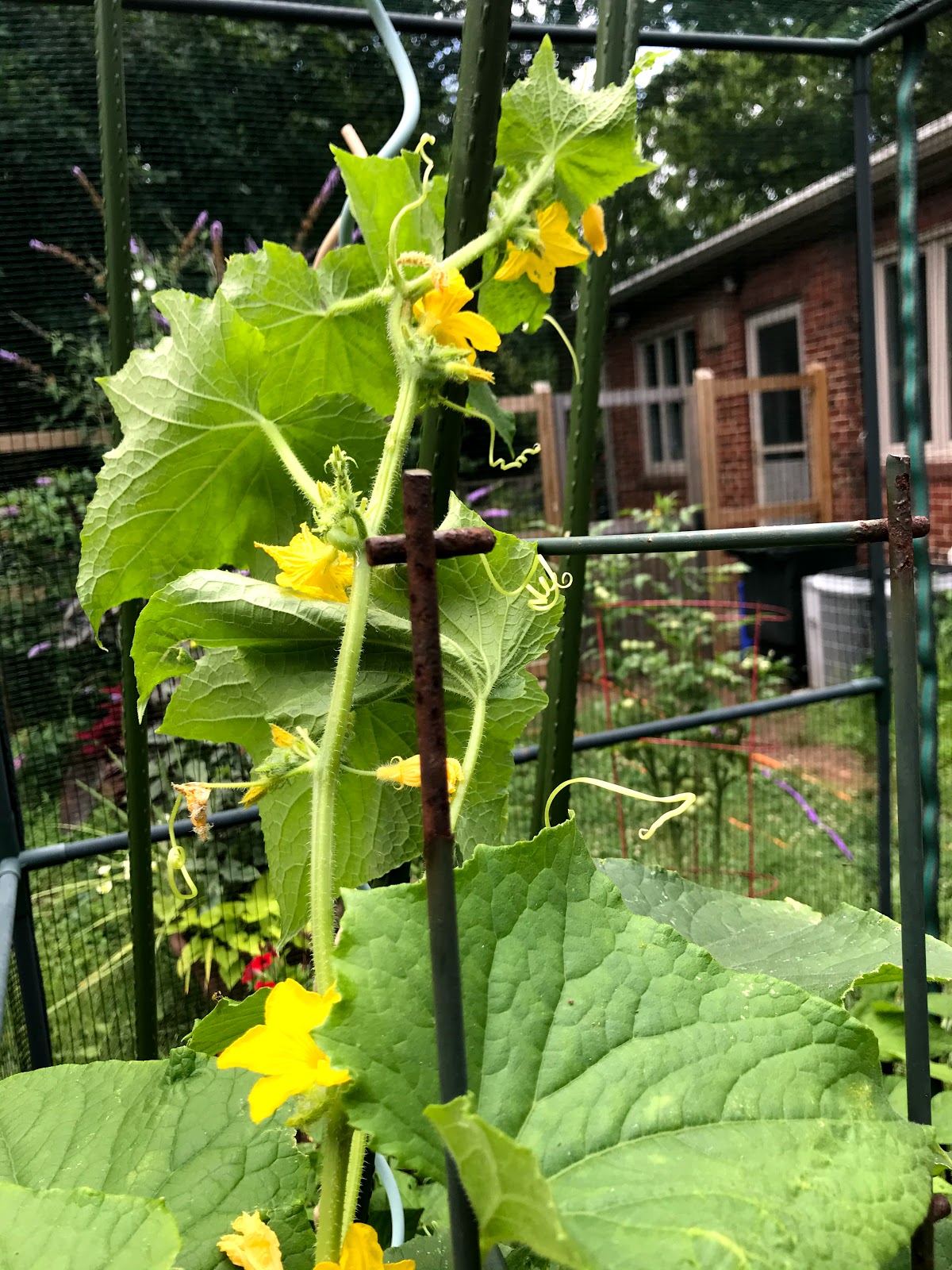
Prickly climbing cucumber
I never eat a lot of cucumbers, but I bought a couple of plants and they are climbing up. The plant is attractive, but the fruits are funny and spiky. There was a cuke recipe in yesterday's paper (basically cukes with egg salad and dill) and I'll give that a try for the one edible one I've got already. I'm eating a lot of salads, so if the cukes are coming I may be able to keep up with them.

Of the haul in the photo at the top, so far I've eaten the cherry tomatoes (snarfed like candy), broccoli (roasted), zucchini (tossed into a chicken saute), and the chard (sauteed with breakfast sausage this morning). I'm doing a salad for lunch (cuke, I'm looking at you) and will think about the beans tomorrow.

I would have to say none of these, except the tomatoes, are head and shoulders better than the usual vegetables I get at Whole Foods. It's still fun, though.

Friday, April 24, 2020

My Garden is Keeping Me Sane

Well, I guess that’s relative, huh? But I can zone out to a task in the garden, with or without listening to music or a book, better than TV or reading (with my eyes) or exercise or anything else doable these days. The task doesn’t have to be much. It’s the micro-examination of each piece of the yard, noting small changes. And, the step back and overview of what should come next.

My plan is to spend a few years (5 or so?) focusing on garden projects and intensive maintenance. By then, I want to have my yard in a place where it is more easily maintained. I plan to spend my declining years sipping cocktails in a beautiful yard that I can mostly just enjoy. I’ve never spent anywhere near as much time out there as I am right now. Everyday, new ideas and new projects surface.
Allegheny pachysandra emerges bright green and by fall
 flattens out to mottled and interesting foliage.

This past (migrainey) week has been spent on gentle projects. I’ve refrained from trips to buy more stuff, and didn’t tackle any of the bigger, more vigorous projects. But looking closely one day, I saw how the Allegheny pachysandra (not to be confused with common garden-center pachy) was spreading into the alumroot. I spent a very enjoyable hour or so digging the alum root and moving it to a new area. I planted the pachysandra a very long time ago, but it got overwhelmed with English ivy and myrtle, and it’s only really surfaced and spread since the fence went up two years ago and I got rid of the ivy. I’ll be content to have the pachysandra continue to spread, without further work, rather than have to defend the alumroot each year. The alumroot in the right conditions will form decent sized clumps, and I have enough bare ground waiting for just such a thing.
Here you can see the surface runners of the
Green-and-Gold

I am filling in bare ground inside the fence, in a shady area that drops off steeply to the neighbor’s yard. I saw an opportunity to be frugal and avoid trips by relocating some other cool plants. I may have pointed out my green-and-gold before, a plant also planted “years ago” that continues to thrive and spread to new places in the yard. It sometimes out-competes more delicate ephemeral wildflowers, so I am removing it from some places, while allowing it to spread in others. So some of that got relocated to a large, mostly bare, spot on the side.

Golden Alexanders is one of my wildflower triumphs. At one point, I got ambitious and tried to start wildflowers from seed. Many perennial wildflowers are very hard to start from seeds, and viable seed for the hard-to-start is hard to come by, because there is not much demand. A source no longer available, the New England Wildflower Society, used to have a seed sale each January. It took two years of learning to successfully buy from there - it was a brief sale without a lot of supply, done via US postal service. Finally, I got seeds for a bunch of varieties. Most didn’t come to much, but it turns out Alexanders are relatively easy. And once established, they seed themselves. Now I have a thriving colony, outside the fence along my stone wall. They seed themselves into the grass there, and I dug a bunch out and put them right away into the nearly blank canvas along the fence.
Golden Alexanders have lacy yellow flowers in spring,
and nice heart-shaped leaves all year.

Now, it’s time to step back and let things in that area just evolve for a while. There was a spicebush and a hosta that predated and survived the fence construction, and I’ve put some ferns in there. Except for some weeding and watering, I’ll just observe that area for now and see how things settle in.

My formerly blank canvas along the fence


Wednesday, April 15, 2020

Aftermath

The gas company has been and gone. A couple of days before they came, I dug out the lilies from the section where I thought they would dig, and put them in big pots I had ready. I also dug out the hellebores from the bed at the house where the new gas meter would go.
The hellebores

As it turns out, they couldn't find the "emergency" shut-off valve buried in my yard, and they dug a series of holes. All of them were in the area I had already taken the plants. At one point, they had three different four-foot deep holes.

Where the lilies used to be
They also came in the house to remove the pipes and old meter. They had to cut through drywall to get stuff out, and they had a carpenter to finally repair the drywall and paint. I had set up the area to minimize how much they would need to move through the house and touch any of my stuff. I heard the carpenter coughing while he did the work, so I ended up mostly keeping the basement off limits afterwards for at least a week.

I was able to put the lilies back almost right away, the next day. I had some bags of soil amendments, and any weeds in the middle of lily patch had been eliminated by the digging. The lilies seem to be thriving, (most of them) so no real harm done. The proof will be in June when they should be blooming.

I put some hellebores into a different place along the house. The bed by the meter needs work (better soil) before I plant anything, and I think I need a bush there because the meter is pretty big.

Needs work.


Friday, March 20, 2020

More Garden Progress

Blood root. I planted some over a decade ago, and the ants 
move the seeds around to make new colonies. 
My records show this is the normal date for it to appear.
It’s usually the first of my wildflowers.
This is my happy place, my reminder that life goes on. I have been out there every day, grubbing in the dirt. This year is odd in my yard, and not just because everything else in the world is off kilter. It’s this screwy year of no winter that  upsets the balance. Unseasonably warm, some plants are sprouting early, while others remain dormant. The difference is driven because plants’ annual cycle can be driven by different factors - temperature, certainly, but also day length and rainfall. So those plants driven out of dormancy by warm weather are sprouting, and those keyed to the light are stubbornly sticking to the schedule they evolved for eons ago. My roses leafed out early, but my wildflowers lag behind. It’s interesting to watch. But it’s also daunting to think about how climate change will affect this - those plants that can adapt to the temperature will do better in the long run.

I’ve done a great deal of garden cleanup. Some of this should have been done last fall, but I leave perennial plants standing over the winter, to provide cover and seeds for critters. Leaf bags are filling up now, though I also have a vacuum mode on my leaf blower, which shreds (dry) leaves into a bag. It can then be used as mulch. I’m also weeding - most of what has sprouted so far are weeds. There are a lot in the garden spaces, because I have only mulched sparsely and the plants are not yet big enough to crowd them out.

So garden areas I’ve cleaned up so far (notes to myself, cleanup means remove debris and weed):

  • My back vegetable raised bed
  • My back-of-the-house flower bed
  • The three little raised beds on the street side
  • Both “down” and “up” on the rounded corner
  • The sunny slope, from the street and stairs up to the bushes
  • Only some of the front garden inside the fence
  • Along the fence by the back patio
My Home Depot garden: Daffs, Hostas, Daylilies, and
Three invisible Blueberries that will leaf out later
The plants I mail-ordered are starting to arrive, plus I picked up a few tidbits at Home Depot. I’ve also got seeds to start, both vegetables and flowers. I planted lettuce seeds in a pot on the patio where later I will do annual herbs (protected from deer by the Big Fence, but it requires protecting from The Very Hungry Labrador, who likes to eat potting soil).  I transplanted six broccoli plants into the back vegetable bed.  I bought a dwarf Alberta spruce and put it in a pot. I put in three hostas from Home Depot along the fence by the back patio. I planted a (jarringly hot pink) moss phlox by the front steps. This last is blooming right now because of forcing by the grower; in subsequent years I believe it will settle down and bloom with other things, and thus be less jarring.

Much work still to do! Because of my previously placed orders, I’m set for a while with projects and planting without needing to venture out to a store. I’m going to order mulch from the high school sale, where it will be delivered in bags at the end of the month. I do consider garden supplies to be essential, and I’m still full of unwarranted bravado in my risk calculations. But I won’t go to the nursery for a while, hoping it remains open so I can go later. I have plans to do a pot farm, because I own a lot of large pots and filling them fits my longer term strategies for less weeding. I’ll need big bags of potting soil, which my local hardware store will load into the car for me. That can wait a bit, because I’ve got an unopened box of plants to tend sitting on my porch right now.


Tuesday, March 10, 2020

Getting Things Done

After the pruning and cleanup.
We’ve had a great stretch of good weather, and I’m making the best of it. On Sunday, I had a date with my neighbor, a chain saw, and a ladder. We finally trimmed the bottom tier of branches on four big trees, which will make a real difference in both light and air beneath them. We got to the redbud and the red oak along the front, and to the pin oak and the redbud on the other street. Not done (we got tired - my neighbor is even older than me!) are the trees in the back.

After a rest,  I spent the first daylight savings evening doing some light weeding while enjoying the late light. I noticed that at least two of the three chrysanthemums I planted last fall are sprouting now. I wasn’t sure they would come back. There are garden mums for landscaping and florist mums for decorating pots in fall, and the three I bought from a big box store were not labeled as perennial. Perhaps it’s just the mild winter, but I’ll consider it a win.

Monday, I finished cleaning up the smaller trim from the branches. I took a pass along the corner, both down by the street and up behind the wall. There were standing stems throughout, and a few weeds to root out. Now the sprouting foliage is all visible along it.
Still working...

I also have been doing a fair amount of planning and on-line shopping. I have a much more clear vision of where I’m going overall. I’m making sure I know what I’m going to do with everything I buy. I’m thinking a separate post for plans and purchases.

Today I did a pass through Home Depot, where things were buzzing from the sudden burst of warm weather. I was there for light bulbs, but I picked up some plants and supplies, again with a clear plan in my mind of where they are to go.

Tomorrow, I’m busy elsewhere much of the day, but I’ve got bite-sized chunks of work to squeeze into the afternoon.

I LOVE this time of year, and it is such a luxury to have the time to do things. I’m not as strong, and I don’t have the stamina I would wish, but I’m getting things done and I assume also building fitness along the way.