Showing posts with label Pests. Show all posts

Friday, October 18, 2024

2024 Vegetable Wrap-Up

My peppers, bought onions
I thought I would recap what happened this year, what worked and what didn't work. It was my most successful vegetable gardening in years. While we haven't had a frost yet, and the plants are mostly still alive, there won't be any more harvests.

First, peppers. I only put them in the Greenstalk, my rotating vertical grower. They did very very well. When I first set them in place, they took a small beating from small pests (holes in the leaves) but I sprayed with an organic bug spray and also trapped many slugs in beer traps, and from then on they took off. I watered daily during the drought and I fertilized them every couple of weeks through the end of July. 

I probably won't grow the same varieties of peppers again. I mostly planted "mini-bells", sweet peppers that only get to be a few inches big. They were very tasty, but WAY TOO MUCH WORK TO EAT!!!  The teeny little things required de-seeding just like a big bell, but it took a lot of them to make a meal. The orange variety seemed much more prolific than the red ones, and I had a purely green, round, one as well (Cupid) with an especially good taste. I also planted one variety of normal-sized banana peppers, long and skinny, and they were good, but more prone to insect damage than the others. I'm going to look for classic bells and fatter Italian frying peppers next year. (I do not do hot peppers.)

And basil! I had SO MUCH basil! I started 24 basil plants from seed, and plopped in a plant to each of the unused slots in the Greenstalk. I had four varieties - Napolitano, Genovese, Tuscany, and Thai. I also put a half-dozen plants into the ground. I had basil extravaganza for the whole summer! It loved the heat, and I watered daily during the drought. The Thai basil plants in the ground got as tall as me! It's not my favorite variety of Thai, I'll look for a new one next year. I bought parsley plants, flat leaf and curly, at farmer's market and put in the Greenstalk, where they did well. I also bought cilantro plants, twice, and placed in the Greenstalk, but they both died quickly.

And tomatoes! I did regular tomatoes in the ground and in individual pots, and cherry tomatoes in the Greenstalks. (Same variety cherry tomato as I grow inside hydroponically.)  I basically got no cherry tomatoes outside, maybe one or two. I think the bunnies may have gotten to them - they were accessible, though slightly protected. And my big tomatoe plants were partially protected. I had four plants in the ground, inside netting that was easily broken by the animals - and it was shredded by them on Bastille Day, in the middle of July, when the plants were bursting with plenty of green tomatoes and no ripe ones. (see this post). I had picked a few green-but-clearly-ripening tomatoes before the massacre. I repaired the damage as best I could a few days later, and the plants survived their haircuts and proceeded to set a new crop of fruit. I got maybe a dozen tomatoes in all (maybe a bit more). The tomato plants in pots were basically unprotected from the critters and took many haircuts besides having fruit stolen. I did get a couple of handfuls of tomatoes from the five plants in pots. I fertilized all the tomato plants every 2-3 weeks (pots slightly more often) through the end of July. I don't think I fertilized after that.

I did two of the three sisters, corn and beans. I got some little corn before the massacre. The beans, inter-planted at the foot of the corn stalks, continued to grow post-massacre, and I harvested a few handfuls of very attractive pods. I shelled the beans, they yielded about 3/4 of a cup, and boiled them, ate them in a vinegar and oil dressing, and was pleased. But I don't know that either the corn or beans were worth the garden space. Corn from the farmer's market is easier, and I like beans from a can. 

I had my best zucchini harvest in years! It wasn't anything to boast about, by zucchini growing standards, but I actually got maybe a dozen or more zucchini to eat! I planted in my raised bed with new soil, and draped the whole thing with insect netting, fastened down all around the edge of the bed. After the plants started blooming with female blossoms, I replaced the fine-meshed insect netting with wider-meshed critter netting, to allow for natural pollination while still keeping the deer, rabbits and squirrels out. I watered, but far from daily, maybe more like weekly. I sprayed the plants with the organic insect spray, put out slug traps (but slugs didn't seem a problem) and sprayed a couple of times with BT, which is specific for caterpillars. I think I thwarted the squash vine borer, which is a moth that lays its eggs inside the vines, for the emergent caterpillars to eat their way out. 


This was my first year for potatoes! I bought seed potatoes on impulse at the hardware store, and I planted them into three 5-gallon growbags. I harvested one bag at the end of July, and the other two about 10 days ago. It was so fun to peel back the bag, and plunge my hands into the dirt feeling for the little potatoes! The thing to worry about potatoes is their turning green. The green is actually just chlorophyll, which is fine, but bad chemicals (solanine) often develop as the potatoes are turning green. I scrubbed, cooked and ate the potatoes the day they were harvested, and I think a few of the potatoes had some solanine. Some of them were bitter to the taste, and I felt queasy after eating them. How odd, but I won't be doing potatoes again. 

But it's all an experiment, and the fun is in the doing and finding out. I don't know what I'll do next year, but whatever I do, I know I need better pest and critter barriers.

Wednesday, July 17, 2024

Gather Ye Rosebuds While Ye May

Munched corn, with a big new hole
in the netting visible.
My garden, on the cusp of delivering on its bountiful promise of just a few days ago, has been decimated! My crop cage, string netting surrounding and covering my big wood bed where my corn and tomatoes are, has been shredded. I think deer may have breached it initially, but yesterday the squirrels made it their own and ravaged it completely. Pretty much every ear of corn has been munched to nothing. The tomatoes are all gone, and the plants are buckled and broken. 

Five years I’ve had the net, and finally it was breached. I think the heat and drought are driving the beasts to get more creative and forceful to eat lush moist vegetables.

Only the basil remains almost untouched. 

I’m so glad I harvested corn and tomatoes when I did. I’ll see what happens to the ravaged tomato plants- they may survive. 

I still have 4 tomato plants in pots, but they have been pruned back by munching deer and aren’t showing a lot of fruit. They are not well protected at all. But squirrels rarely go there. We’ll see how it goes.

I also have the greenstalk towers, with cherry tomatoes and tiny peppers, and basil. Something to take care of and pick from. I also have the zucchini, sequestered in its own bed. It’s protected from a casual browse, but not from a determined assault. 

Now I have to think through more sturdy pest control solutions. Sigh. 

Sunday, July 14, 2024

Tomato Massacre

This morning, when I went out to water my plants in pots, I discovered one of them had been completely massacred! The huge pot had been overturned and emptied with the dirt spread all over the driveway. The large Early Girl tomato plant, previously covered with green tomatoes, was snapped off at the ground level, shredded and denuded of all fruit. Sigh. All gone, nothing to do about it. I assume a deer. I moved around my remaining pots to use my large lime tree (which has thorns) to protect the remaining pots. But they are not behind a big fence, so they remain vulnerable.

But it's far from only bad news in the garden. I decided to make a harvest today, partly because I figured I'd better grab some before the animals do!


I've got a small harvest of tomatoes, mostly salad-sized, mostly Early Girl variety. I picked some that are not yet fully ripe - there is a school of thought that says it relieves the plant of a burden so it can continue to make more tomatoes. Once tomatoes start to ripen, they will continue even if picked. And flavor is based on the variety of tomato, not on maturity when picked. (Modern tasteless supermarket tomatoes result from breeding varieties for good transport qualities while ignoring taste - it doesn't have to do with when they are picked.)

I planted a few pepper varieties, based on seeds I already had in the house. None of the peppers are full-sized bell peppers. I've got banana peppers, and small bells that will turn bright colors. I picked some yellow bananas and tiny green bells. I'll probably let the next tranche ripen to more vivid colors.
I went ahead and picked some of my corn! What I read was it's ready to be picked when the corn silk turns brown. But I saw ears with a lot of the silk just gone - and the ears had a lot of ants crawling on them. All of my gardening is only entertainment and experiments, so I figured let's just go see whats going on inside the husks. 


The ears are small and misshapen, and the kernels are irregular. But there are some regular-sized kernals, and I think I'll use a knife to cut off the good ones and cook them in a skillet as part of a veggie saute. (Apparently each thread of cornsilk is tied to a specific kernel - if it gets fertilized, it grows into a plump kernel.)

I've also made my zucchini more vulnerable to pests, but also open to being pollinated by insects. I had it completely under insect mesh, and I attempted some manual fertilization. But I haven't had great success with that. I was defending against a pest called the Squash Vine Borer, but supposedly it's an early season pest, so the odds are much less it will show up now. So now it's under a larger plastic mesh, which hopefully keeps deer and rabbits away, but allows the beneficial insects in.

Wednesday, June 1, 2022

Wildlife in my Garden

The pagoda dogwood watched by Bixby

 I have a very wildlife friendly yard. Bixby and I have amused ourselves for hours watching birds and squirrels and rabbits and their antics. One memorable moment was spent watching two nuthatches chasing each other around and around the trunk of my tulip tree, up and down. (Nuthatches are one of the few birds I recognize, because they are the only ones that spend a lot of time head down on tree trunks.)  I watched a squirrel on the very tallest, thinnest, branches of one of my service berries, clinging perilously with three paws as the fourth brought the berries to his mouth. From my living room couch, I watched many different kinds of bee-like creatures pollinating away on the many-small-flowers-in-a-cluster pagoda dogwood just outside the window. Now I can see the small, hard, round berries ripening all over it, and I know from experience they are a big favorite with the birds.

Maybe the begonia will come back?
Much sex has gone on in this yard!

But not all wildlife is welcome everywhere. I'm all in on trying to maximize pest control this year. I want an ornamental and productive garden!

Deer, of course, are the worst, but rabbits and squirrels also take a toll. I've paid attention to what plants are most subject to mammal munching, and I've tried to make sure that anything not on that list have some form of protection before being placed outside the high fence. I judged wrong, and my lovely begonia is down to just stems, in what may have been a single deer mouthful!

Netted flowers

I've put thin plastic netting over my three small square shady beds along the Court, and so far it seems to be holding off disaster. I had put a couple of strawberry plants in one of them, and before the netting went up they got eaten to nubs three separate times (luckily, they still had roots). Now, with the netting, they are growing and blooming. I don't expect any strawberries this year - my goal is to have them come back next year. I've got dahlias and cosmos and zinnias and chrysanthemums in the other small beds - these are all of varying attractiveness to deer.

The vegetable cage
I've had netting around all sides and the top of my 4' x 8' vegetable bed for a few years now, and it reliably keeps anything larger than a half inch out. I've got peas coming along in there, a favorite of rabbits (planted in March, only started blooming a couple of weeks ago). I put tomatoes and eggplants and peppers in there, the first time I've planted them in the ground in three years. I'm hoping the soil-borne viruses are gone. I'm trying tomatoes and eggplants in pots in another sunny spot in the yard, and I had them surrounded by a short 2' pet fence (keeping out rabbits) and under a translucent woven fabric cover, making an impregnable fortress until the tomatoes and eggplants started blooming. Since then, I've rolled up the sides hoping for pollinators but also hoping the deer won't munch through the openings. I've got some tomatoes and eggplants and peppers in pots inside the fence, vulnerable to squirrels but not deer. 

The big thing is a 4-line beetle and
the white specs are aphids


I'm examining these plants daily, and some of the bottom leaves turned yellow. I decided they needed fertilizer, and I had some granular stuff from past years. (Mice had nested in the bag, but I decided the stuff at the bottom of the bag was probably still good.) I've applied that a couple of times, and also cut off all the yellow leaves, and I think they are looking better. 

Asian lady beetle

But my eggplants and tomatoes have aphids! They are horrible white flecks that seem to twitch convulsively, clustered at the top of the plants. The internet suggested a jet of water to blow them away, and also suggested neem oil to kill them. So almost daily, I'm hosing them down, (which makes the bugs disappear for at least the next few hours) and at least once a week following up with sprayed neem oil. I may be gaining on them, at least fewer leaves appear to be chewed. I did spot a lady beetle on one of the aphid-infested eggplants. It was an asian lady beetle, according my app, but it still likes to feed on aphids, so I left it alone.

Potted tomatoes, peppers,
eggplants and zucchini,
inside a tent fortress

I started zucchini from seed in my biggest pot. I put a solid row cover wrap over the whole pot to ward off vine borers. Once the zucchini starts blooming, I'll have to decide if I'm hand pollinating, or if I'm going to individually wrap each stem in aluminum foil to keep the borers out. 

I harvested arugula and lettuce on different days. In each case, I filled the sink with water, dumped in the leaves, and washed each leaf individually, examining for slugs and earwigs and deciding if there was enough un-munched leaf to eat. There was so much arugula that I ended up cooking it (sauteed with onions, finished with lemon juice) so I wasn't worried about residual live bugs, but I still examine each forkful of lettuce suspiciously before putting it in my mouth. Several hours after the lettuce wash, I discovered a tiny slug on the kitchen counter making a break for it in his (ahem) sluggish way towards the dark behind the coffee pot. Yuck!

With all this hand-tending, can I call any vegetable harvest "bespoke"?

Mighty big bowl of arugula

In my natural wildflower garden in the front of the house, there aren't really any pests, just critters trying to live their lives. But after doing some weeding there, the next day I discovered an embedded tick on my calf. I took a picture before I removed it, and found a (University of Rhode Island) website where you can upload a picture of a tick and they will identify it, and tell you what diseases it may carry. I had a lone-star tick, and it does NOT carry lyme disease. But it does carry other viruses that can cause fevers, and also a weird enzyme that can cause a lifetime allergy to red (i.e. mammalian) meat. I just finished a murder mystery yesterday where someone who had that allergy was killed by slipping her some beef-based protein powder! Ooops?


Saturday, April 2, 2022

Spa Day

The weather climbed up into the seventies this week, and I decided it was time to give all my houseplants a bath. I’ve had a minor spider mite infestation, and wanted to tackle it before it became major. Many houseplant books recommend washing plants regularly to remove dust and pests. I’ve seen instagrams of folks taking a shower with their plants (check out urban jungle blog). My shower was broken and too small anyway, so the window of warmth allowed me to proceed. 

First they all went outside, then they all got hosed down. After a brief drying period, they all got sprayed with neem oil and went back inside.

Bixby has a thing for spraying water. He goes nuts chasing the stream and has to jump and bite it. So he participated in the plant wash, and proceeded to roll in the dirt to dry off, and so he got a dog wash in the kitchen sink. I bought the only bottle of dog shampoo at CVS, and the advanced oatmeal formula has made him fluffy and nicely fresh smelling.

I completed my spa day by fixing my broken shower and cleaning myself off. My old shower knobs used to leak, were fixed by a plumber and replaced with ugly plastic knobs, which only lasted a couple of years. Another trip by the plumber gave me a new set of plastic, and when they started to spin freely this year, I decided to tackle it myself. But matching old parts is hard. I ended up, after three visits, with metal inside but plastic outside “universal” knobs, that don’t match but work. This is clearly a temporary fix, but “temporary” could be a couple of months or a few years. The joy of old houses!

Saturday, October 9, 2021

Milkweeds Doing Their Job

Milkweeds, of course, are the food source for monarch butterfly caterpillars. The several species of milkweed are pretty weedy. I've planted one of the least ugly, Asclepias tuberosa, the orange "butterfly weed". I've never seen any monarch caterpillars on them, however. 

But I've also had the weedier common milkweed, Asclepias syriaca, crop up as a volunteer on my shady, steep bank along the road in front. It would prefer more sun than that location has, and so it is only on the edges, leaning over the road and the steps to my front door. It is quite unattractive, even in bloom. This year, it really went to town, and I was pleased to see an excellent crop of monarch caterpillars on the plants. The plants were completely stripped, and I hope there were enough of them to feed the caterpillars all the way through pupating - this is probably why it's recommended a butterfly garden have a sizeable patch, not just one or two plants. Encouraged, when the caterpillars were gone, I cut off some of the seed pods and tossed them further up the bank, hopefully to see more plants.


Sunday, September 13, 2020

Wildlife in the Garden

 Besides the usual deer and rabbits, there have been a host of interesting small critters in the garden.

This is a June Bug

The honeycomb left by my yellowjackets

Skipper 

Eastern Swallowtail Butterfly

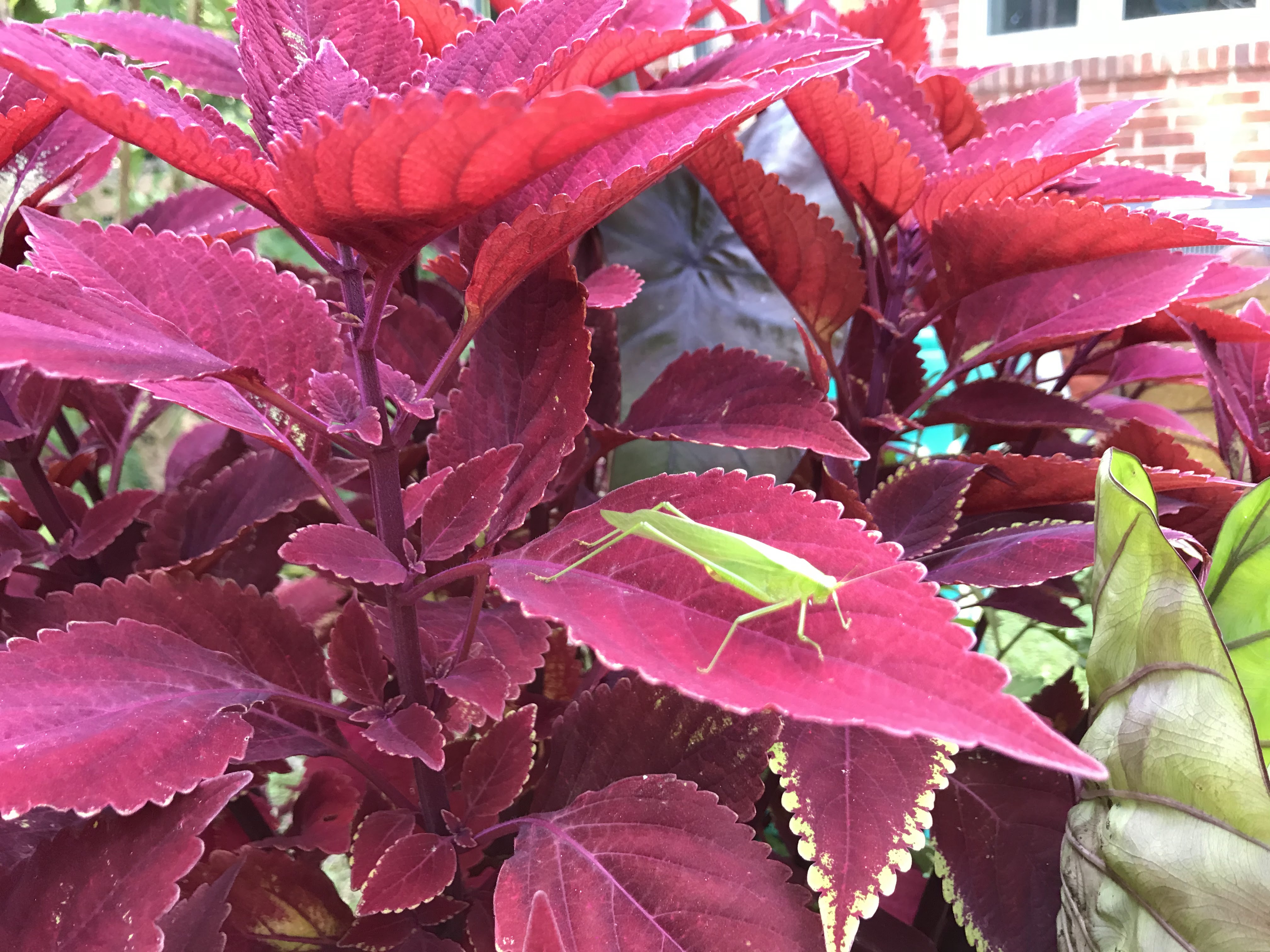
A katydid. I thought it was just a “common” but then
some expert brandishing his credentials including a shiny new PhD
said it was something much more obscure.

The dark form of the Eastern Swallowtail

Pollinators, including bees, totally adore this verbesina.
I weeded a bunch of it out today, and bees rode it down into the 
Trash bag and came out later, startling me. 


Saturday, August 1, 2020

Miscellany.

The latest crop of garden porn
I spent yesterday's rainy day with a bunch of new garden books. Big gorgeous books I still buy in physical form and luxuriate in their size and heft. I don't read every word in these books - I read some, and generally flip every page and admire most of the pictures. Then they go on the shelf, and are referred back to fairly often.

The bee guy came back for another shot at my yellow jackets. They are now fairly unhappy, meaning maybe another day mostly inside.
Dead girls flying? I hope!

The rainy weather has kept things moving along in the garden. I have a small forest of mushrooms (possibly brought in by the mulch?) and my favorite huge "dinner plate" hibiscus.

It's actually redder (less pink) than this photo shows.


Thursday, July 30, 2020

Apples!

I have an apple tree (I used to have two but I got rid of one this winter because it was too big too close to the house) and I've never eaten an apple from it. I've watched it bloom, I've watched tiny apples form, I've watched them grow,  and slowly, slowly, I've watched small amounts of red creep across them. Just when I've thought it's time to try picking, they all disappear. I've known it's deer and squirrels - the highest apples are well above the reach of deer. But I've always timed it wrong. This year, I've been able to watch it much more closely than in other years, and the apples are growing bigger, slowly. Few have any red - interestingly, the reddest ones are the smallest.

Earlier this week, Rocky and I came back from our stroll around the block to find a deer grazing on the tree. Grrr! She was very bold and hard to shoo away. (I should note that Rocky's only interest in deer is their poop they leave behind - yummy!) "Shoo!" made no difference to her. "Woof woof!" (from me) made no difference to her. She seemed very big when we got close. She sidled a few feet away, and she kept an eye on Rocky, but she decided to sample the dahlias and mums that were closer. I grabbed my deer-chaser I keep on my front porch: a metal coffee can with a few nuts and bolts inside. I shook it at her, and finally she wandered across the street to eat Betty's flowers. Hat-tip to my neighbor Bill for suggesting that was a noise that was likely to work - I've used it several times this year, to good affect.


A couple of nights ago, I was down in my basement gym (yay me!), flat on my back, and I looked up and out the huge window well there, and I saw a squirrel on the tree. What he seemed to be doing was sampling every apple by taking a single bite! Grrrr! I finished up the workout briskly instead of lingering over my stretches, and went out there. The squirrel was not in sight, and I took the moment to harvest a few apples even though they are still green. I carefully positioned them for the photo with best side forward, because they all have flaws (but no actual squirrel bites). The largest one is about the size of a peach, small for an apple.

I'm contemplating my next move.  Will the picked green apples ripen or rot? Harvesting a lot more apples requires hauling out the ladder. I want to delay that as long as possible, in the hope they will continue to grow and eventually ripen. But will they all be gone by then? Yesterday, I saw a squirrel perched atop my fence enjoying one.

In other news, the yellow jackets are not gone. They have opened a new nest entrance about six inches from the old one. The specialist says he'll be back Saturday. Grrrr!

Thursday, July 23, 2020

ATTACKED!! 2020: This Time, It's Personal!

On Sunday, one of the hottest days of the year (so far), I was moving hoses around, preparing to water my garden. Suddenly, an intense sharp pain on my knee made me aware of several buzzing yellow jackets! The back of the other knee got nailed! My shin! I started to flee, and I noticed the dog had gone full Eeyore on me: head down, ears down, tail down, feet firmly rooted in one spot, at least a half dozen yellow jackets buzzing him.
Doomed! The white dust is from the exterminator.
The lower nest is blocked, and the entrance is full of poison.

In an incredible act of courage, I hobbled over to Rocky, and grabbed his collar. The back of my hand got nailed by a stinger. I shrieked at the sad dog, terrified of the numerous persistent pursuing insects, and Rocky planted his feet more solidly and refused to move. I dragged him by the collar, out the gate and halfway around the house, brushing yellow jackets off him and then me as we went. Poor Rocky was stumbling and almost falling, perhaps as terrified by me as by the stingers.

I got us inside, verified we had left all pursuers outside, and assessed the damage. I had at least six stings on arms and legs, and they were already incredibly painful and swelling up fast. Rocky was still in Eeyore mode, but didn't flinch when I patted him.

I've never been particularly bothered by bees. When I've been stung before, it hurts, it swells, and in an hour or two it looks and feels itchy like most people's mosquito bites. (I am even more indifferent to mosquitoes, usually.)  But I am aware that many stings can bring on anaphylactic shock, and I'd never felt anything as painful as this. I raided the medicine cabinet, first for Rocky, then for me - antihistamines and painkillers all round. I texted my BIL to keep checking back with me for the next couple of hours, to make sure I hadn't started gasping for breath.

Of course then I took to the internet to figure out what these infernal pests were, studying the nest through the window. Clearly territorial yellow jackets, not bees. There were DIY solutions for getting rid of ground nests on the internet, but neighbors strongly recommended a local one-man specialty service. With my left hand already swollen so it was hardly functional, I decided to wimp out and go with the expert.

The stings continued to swell, reaching a good six inches in angry painful diameter each. Monday was worse than Sunday, but then they started to recede and now, five days later, they are roughly mosquito-bite itchy, not painful, but still large and red. I have a new healthy respect for all things stinging.

The "Bee-Be-Gone" guy has just left, noting the nest had taken advantage of tunneling mammals - probably voles - so the nest was very deep and long. He had to go with poison, not just mechanical means, to get rid of them. So now the front yard is filled with extremely perturbed angry flying things with nasty pointy ends that pack a poison of their own. It will take up to three days for the activity to die down, and if there is any residual flying activity in a week my guy will come back and do it again.

Bad Nature! Bad bad nature!

BTW, this is only a few feet from where I had a welcome distanced outdoor chat with Liz last week. Luckily, we didn't inadvertently bother the nest, and they didn't bother us then. What a debacle that would have been!

Saturday, July 20, 2019

Attacked!


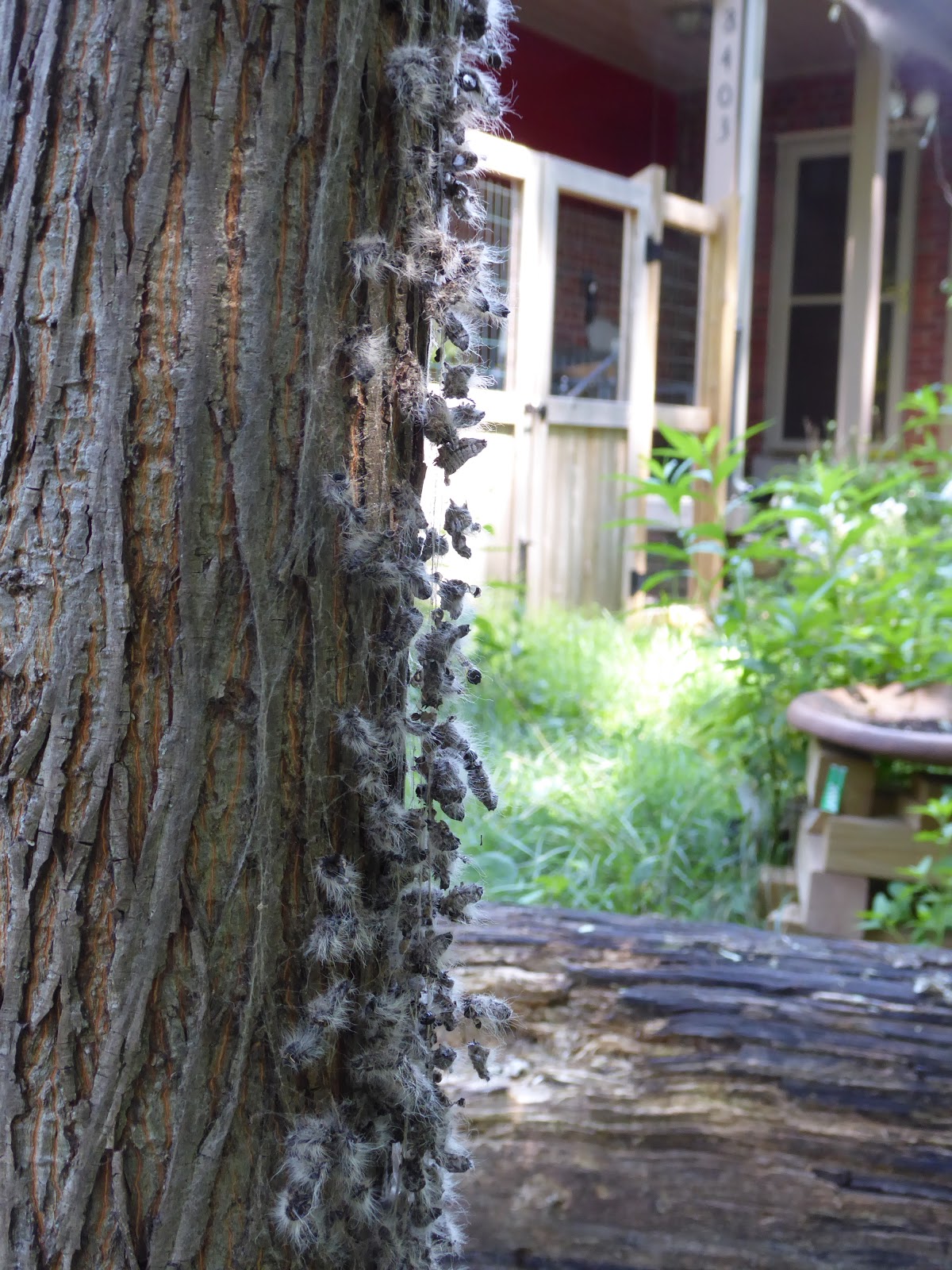
I noticed, idly, a couple of days ago that my adolescent shagbark hickory had lost some leaves on one of its branches. Yesterday, I looked out the window and at least half of the leaves were missing! There were green spines from some of the leaves on the denuded branches, so I assumed someone was eating it.

I took some pictures and posted them on the local neighborhood listserve, and also a local gardening one. The pictures weren't great, and I didn't get a lot of useful information. I dug out my camera with a long lens, and its battery was dead. An hour of charging later, I went out and took some high resolution photos and found these caterpillars. Also residue (previous instars?) on the trunk. And under the tree, it was very unpleasant, it appeared to be raining caterpillar poop (scientific name "frass").


The tree, planted by me as a stick about 15 years ago, is way too tall for me to be able to reach where the caterpillars were to spray with chemicals. Instead, I sprayed them with a high pressure stream of water from the ground, which knocked some of them off the tree, and maybe annoyed the others. But considering how hot it was, it was probably well received by them. I also topped off the bird bath, thinking birds were my only hope.

 This morning, I didn't see any caterpillars when I went out, but I bought some Bt. This is a bacteria that is specific to kill caterpillars and not much else, and doesn't persist in the environment. When I got back, I saw a regular parade of caterpillars making their way from my hickory, across the front walk, and headed steadily north under the azaleas in the shade. For no reason other than vindictiveness, I made it rain Bt on their parade. There was satisfaction in this.

I also preemptively sprayed my only other hickory, on the ground and on the trunk, though it wasn't their direction.

Healthy, established trees should be able to withstand being eaten for as many as two years in a row. Sadly, this tree was subject to big stress last year when the Big Spruce fell. On its way down, its branches grabbed the hickory and bent it double, all the way to the ground. When the crew came to remove the Big Spruce, I pointed out this hickory and said I wanted to save it. They were glad to have it pointed out, because these trees might whip back up and cause injury. As it turns out, it only came partially up. The arborist gave it a less than 50-50 chance to survive. This spring, it seemed to be quite healthy. It leaned, but it was filling out and growing straight on the new growth.

Luckily, it doesn't threaten my house or any powerlines, so I can just allow nature to take its course. If it lives, great, and if not, it just means more light and an opportunity to plant something else.

Friday, June 27, 2014

Shoo!

I've got a couple of days off work and am putting a fair amount of effort into the yard. I believe that I have already done more work on the garden this year than all of last year.  Things are sprouting and growing everywhere, so it's not like I can stop and rest on my laurels.

The deer are a huge problem. They are shameless, and they are voracious. There is a path where they come up into my yard from Paul Robbins' yard, wander through the front, around to the side, poop there, and maybe detour briefly to the back bed behind the house. They have eaten back my tomato plants, but not killed them. I need to figure out how to protect them, while still allowing myself access to them. So I'm contemplating a small construction project.

The back bed has corn and beans. I thought that bed would work because the tulips that I planted years ago have come up each year and bloomed without getting eaten. But shortly after things sprouted, the deer made at least a brief pit stop, chomping the bean stalks and making big footprints in the bed. Before I left on vacation, I partially wrapped the bed in bird netting. That looks ugly but seems to have worked. I returned to find many weeds, mostly bindweed and the fleshy thing (saxifrage?).  I had to work my way through the netting to weed it, and cursed the infernal clingy stuff throughout. I bought supplies to make something better, but don't know what best to do.

I also want to protect the tomatoes, and yesterday I planted zucchini and sunflowers in the other small squares by the street. I know from experience they will need to be protected. I'm wondering about something for each bed, or something that covers the whole territory. But whatever I do, I want better aesthetics than I've got with the bird netting.

Since I have something ugly that works for now with the corn, the sunflowers and tomatoes and zukes are the priority.

Yesterday I had sauteed zucchini (from Whole Foods) a myriad of herbs from the garden. Yum!

I have blueberries marching towards ripeness, and many apples. I think it would be good to try to protect a few of each. Not sure if I can.